
Every so often, there comes a game which I like to save for myself. A game that I do not give to one of my esteemed colleagues to review. Electronic Arts’ Dead Space is one such title. 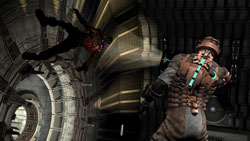 I had a vague idea of what to expect from seeing it played briefly at this year’s E3 Media and Business Summit. At least, I thought I did. I guess seeing it played in a brightly lit convention room flooded with fellow gamers is a lot different than sitting down in a darkened room to play it by myself.
Fighting off the feeling that I had become a shut-in, I turned the lights off and started up Dead Space. So far so good, the intro UI is not scary. It is creepy but I am handling it. The score is eerie from the get go – brilliantly composed. So, into the introductory scene I go. It starts off with wonder and good excitement. After all, you are experiencing the majesty of space and mankind’s achievements therein. Then, it all goes wrong, and from that point forward you are in for one hell of a ride.
You play as Isaac Clarke, an engineer who is sent as part of a small repair team to find the ‘planet cracker’ ISG Ishimura and fix whatever is wrong with her. What you find is that the ship has been taken over by strange lifeforms called ‘necromorphs’. Whatever this life form is, it seems to utilize the biological matter available to it in its pursuits. In this case, the Ishimura’s crew.  The design of the necromorphs is perfect. They look to be inspired by Rob Bottin’s and Lance Anderson’s work in John Carpenter’s 1982 film, The Thing. This fact alone did not bode well for me, as growing up The Thing was the only movie to ever really scare me. The idea of something using your own body for its grotesque purposes just creeped me out, and still does. Killing these abominations is a matter of tactics, just not spraying and praying. You have to dismember them first by blowing off their limbs/tentacles. This will usually kill the creature. If you try shooting it in the torso or head on the other hand, you will usually just piss it off. Trust me, don’t piss them off if you can help it.
The dark corridors and gruesome details adorning the Ishimura’s innards just wreak horrific atmosphere and you will often find yourself creeping around corners at a snail’s pace, gripped with anticipation of certain death.
Thankfully, Isaac wears a protective suit which helps him take more punishment that a normal person could. This suit can be upgraded by the use of ‘store’ terminals placed around the ship. Additionally, your weapons and armor can be upgraded at workbenches by using special ‘power nodes’ found scattered about.
Even with all this upgrading, you will usually feel very weak in relation to your enemies. Problem with Mr. Isaac Clarke is that he is an engineer, not a space marine. 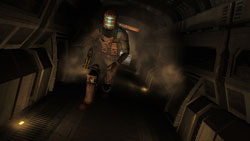 Your weaponry will consist mostly of unusual tools such as a plasma cutter. You will get a couple more standard military weapons, but ammo is nice and sparse in the game leaving you constantly hungry for more. You will also get some other engineering hardware which allows you to move things from far away, a sort of engineering telekinesis. Issac also gets to play with a stasis tool which slows down whatever object he hits with it. This can range from a fast-moving obstacle to a fast-moving tentacled infant-monster (creepy). This, coupled with your finite inventory space can lead to much pondering over what to keep with you and what to leave behind.
Dead Space has a very eerie score which procedurally changes depending on what you do in the game. The composer of the base chords and melodies, Jason Graves, does to your ears what the art direction does to your eyes.
I must admit, I could only take playing in the pitch-black for so long. I think I lasted about a half hour before the intensity just got too much and I had to light the place up with warm and friendly photons. The problem with this logic is that while lighting up my living room makes me feel better here in the real world, poor Isaac has no such luck. Even lit areas could become death traps in an instant.
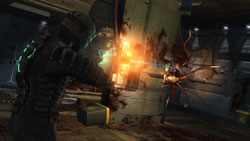 There are several other cool gameplay gimmicks in the game, even having to do with zero gravity, however I will not spoil anything more for you. Dead Space is one of those games which you just have to experience for yourself. If I can tell you one thing in this review, it is that if you usually enjoy shooters, creepy survival-horror titles, or sci-fi horror in general you will love Dead Space and should buy it right now. Go and support quality productions like this. There are far too few of them to let this one pass you by. And for goodness’ sake, try playing in the dark to start with just to get the full effect. Good luck…
 Usually, we are nothing but excited with sandbox games. The freedom one derives from exploration can be quite liberating. In an RPG it is also equally nice to have some sort of overall quest which ties the whole thing together. TaleWorlds has decided to just keep with the sandbox part of that equation, ditching an overall quest and thrusting gamers into the unknown.
 The battlefield strategy employed in these large skirmishes is vital as one false swing or direction can mean the turn of the tide. Commanding troops is done easily by shouting commands at them. They are fairly basic commands but mirror what a human being would be able to shout while riding into battle. This adds an additional element of realism to the combat, as knights in the middle ages did not have GPS or other high-tech gadgets with which to organize themselves.
 The character development is fairly complex, TaleWorlds taking a queue from Daggerfall in asking you a series of questions to determining your base character. From there, you allocate some skillpoints are off you go. Along the way you level up your character, increasing your skill points and personal wealth.
 Reel Deal Millionaire’s Club manages to walk this line of graphics and budget nicely, as it is the first time I can remember a Phantom EFX game with 3d elements to it. All of the cards are 3d as is your character’s avatar. Yes, you heard me: in this Phantom EFX title, you will actually create a full-bodied, 3d avatar for your player. After creation, the avatar will sit in your ‘place’ at the table game and react to the game’s outcomes in an often humorous manner. I chuckled after losing a big bet in blackjack at seeing my avatar slap his forehead in disbelief. It was as though his small, pixelated mind had bonded with my own. While the 3d characters are not exactly the most attractive Johns and Janes this side of the Mississippi, they are modeled nicely enough, especially when viewed in their ‘shrunken’ state at the bottom of your screen.
 Not to spend too much time discussing the graphical overhaul of the game, Phantom EFX has added eleven new slot machines to the game which are not found on any of their other titles. As usual, their video machine UI’s are crisp and vibrant. However, I did experience an odd bug in which the machines were completely silent while the MP3 player was active. Turning the player off unmuted the machines. I expect this and other bugs to be fixed in subsequent patches as is often the case.
 Phantom EFX has a new edition of their popular Reel Deal Card Games series out. This one, dubbed the ’09 edition, contains over 80 card games for you to experience. While most of the Reel Deal series has something to do with casino gaming and is marketed as such, Card Games ’09 is geared to the average card player. By card player, I do not mean poker necessarily, although that is included within this game too. I mean the player of games such as solitaire or bridge. Even without it being casino-focused, the games featured in this product all have a gambling component. Nothing ventured as the old saying goes! If you are familiar with Phantom EFX’s previous games you should have no problem adjusting to this one. Their UI’s are consistently friendly and show a good degree of forethought.

 I suppose I would too if someone came up to me with a bone through their nose.
 Although the destructable environment was a little bit too easily destroyed, it sure was fun taking that place down to kibble.
 The Wizard was a great long range direct damage dealer. While the dogs were doing their thing and the spiders and disease slowly crumbled the undead, the Wizard’s spells simply decimated the remaining remains. I can imagine the Witch Doctor could play through the game without an issue by himself (although, what fun is that?). The Wizard would be a cautious solo artist, taking care to watch mana at all times because when it runs out, you’ll die quicker than a ninety year old smoker.


 So with the original King’s Bounty released in 1990, the game’s rich universe cooled its heels while franchises such as Heroes of Might and Magic and Disciples took its place. All of these popular games knew where they came from, and King’s Bounty is even listed as the genesis of the Heroes of Might and Magic series in its third installment! It is now 2008, eighteen years since the release of the original and Atari, 1C, and Katauri Interactive have brought the King’s Bounty universe back to life with King’s Bounty: The Legend.
 The combat is fully turn-based and brings a good deal of that old-school gameplay to the more modern aspects of the game which allow it to feel fun and not stale (often times in gaming, ‘retro’ means stale).
 **This issue has an update to it in the Live Updates section. Another issue which I found to be irritating is the game’s auto-save feature which does not save your status prior to a battle. I found this out the hard way when I bit off more than I could chew by attacking an undead castle. I was slaughtered and had to load a game that set me back quite a bit. Manual saving is easily done, however the game is so engrossing you will find that you forget to do it!
 All of these elements combine wonderfully in King’s Bounty: The Legend, which succeeds in bringing the fun of classic turn-based strategy games into the 21st century, improving on them with modern features when possible. It delivers approximately 40 hours of gameplay and you will probably play through the entire game as each of the character types, not to mention all of the different army makeups you could possible have. This kind of replayability makes King’s Bounty: The Legend one of the easiest game purchases you will ever make.
 Oh sure, the preview stuff had looked interesting and sometimes blew me away (the Emotion demo vids for instance) but you can’t always tell when it comes to a Star Wars these days. How are we to trust Lucasfilm, LucasArts, Lucas* when we, as fans, have received such a spotty track record of both awesomeness and lameness? Anyhow, so I start the game and the main theme kicks off with the Star Wars logo. It slowly moves into the cosmos and the title crawl begins. I am already hooked. Why is it that just this alone is enough to fire my geek engine like nothing else? So at this point I am very excited to get past the opening crawl but remember Master Yoda’s teachings and utilize some of this mystical mojo we call ‘patience’ to see it through.
 Now, it finally dawned on me where I had seen this character’s face before. I am sitting there and I blurt out, ‘Hey, Starkiller was on BSG!’, much to the funny looks from my two cohorts beside me. You see, Sam Witwer, who played ‘Crashdown’ on the re-imagined Battlestar Galactica series is Vader’s young apprentice. He not only voices the character but also lends his face to the game. They have modeled it extremely well and, unlike Kristen Bell in Assassin’s Creed, is very recognizable even without a lab ID card on his bosom. Not only that, but Witwer puts in a great performance and is a total credit to this game.
 The aforementioned actors as well as the rest of the cast all put it incredible performances and I can’t think of anyone who came off as ‘wooden’ or unbelievable. The rendering of the cutscenes is equally incredible and makes me wish LucasFilm would have focused on turning this into a CGI film instead of the Clone Wars. And guess what? There is not a single fart joke in this entire beast, imagine that!
 The camera will zoom out from behind you and move to some angle to try and frame the entire room in which you are fighting. Problem is, that when zoomed out, it is easy to lose your character (or the enemy’s) when the objects really start getting knocked about. Additionally, targeting between anything becomes more difficult as your perspective is off from your character’s (on which targeting is based). Aside from the camera, levels seem to spottily move from easy to insane in terms of difficulty level. While an increasing scale of difficulty is to be expected in most games, these seemingly random patches of insanity definitely keep you on your toes.
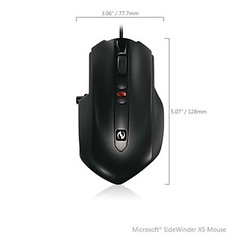 The X5 features a hard, black plastic design, save for the cap pieces which are rubberized, with a rubber scroll wheel and plastic vertical side buttons. The high-gloss, plastic center strip houses the scroll wheel, DPI, and Quick Turn buttons. Not a flashy gaming mouse, the X5 is only equipped with two rear-mounted undercarriage lights. Its minimalistic aesthetic gives an air of dignity to the mouse in a category where gamers often pay more for flash than function. Thankfully, the X5 makes up for its lack of lighting effects with a variable-DPI laser sensor.
 Gone are the adjustable weights and interchangeable feet of the original Sidewinder, but they are not missed here in the least. The X5 shows that you do not need those frills in order to be effective in-game.