Star Wars. The name conjures up images of epic space battles, mystical energies, the battle between good and evil, and even the conflicts that rage between children and their parents. A bit about me: I was less than pleased with the latest trilogy of movies and just displeased as possible with the CGI Clone Wars film. I did, however, love the animated Clone Wars series and, of course, the original trilogy (Han shoots first dammit).
So you can imagine my apprehension when sitting down to play Star Wars: The Force Unleashed.
Oh sure, the preview stuff had looked interesting and sometimes blew me away (the Emotion demo vids for instance) but you can’t always tell when it comes to a Star Wars these days. How are we to trust Lucasfilm, LucasArts, Lucas* when we, as fans, have received such a spotty track record of both awesomeness and lameness? Anyhow, so I start the game and the main theme kicks off with the Star Wars logo. It slowly moves into the cosmos and the title crawl begins. I am already hooked. Why is it that just this alone is enough to fire my geek engine like nothing else? So at this point I am very excited to get past the opening crawl but remember Master Yoda’s teachings and utilize some of this mystical mojo we call ‘patience’ to see it through.
And then LucasArts might as well have shot me with a dart of pure adrenaline because you start the game playing as ‘the man’, Darth Vader himself. And, it does not disappoint. Without spoiling it for you guys, the situation in which you find yourself in and what you must do during the first level are the things of geek legend. I kid you not.
Enter ‘Starkiller’, a young boy who Vader finds and takes as his own apprentice, we assume raising him (how much of an extent is not really seen) as well as Vader could given his busy schedule of slaughtering Jedi and being the errand boy for Emperor Palpatine.
Now, it finally dawned on me where I had seen this character’s face before. I am sitting there and I blurt out, ‘Hey, Starkiller was on BSG!’, much to the funny looks from my two cohorts beside me. You see, Sam Witwer, who played ‘Crashdown’ on the re-imagined Battlestar Galactica series is Vader’s young apprentice. He not only voices the character but also lends his face to the game. They have modeled it extremely well and, unlike Kristen Bell in Assassin’s Creed, is very recognizable even without a lab ID card on his bosom. Not only that, but Witwer puts in a great performance and is a total credit to this game.
Vader is voiced by none other than Chad Vader’s Matt Sloan (who voices Vader in that series of shorts too). This guy is incredible, the BEST Vader in a video game or movie since James Earl Jones. I did not hear one line uttered from him that did not sound spot-on. If the guys at LucasFilm and LucasArts were smart, they would hire him from now own as Vader’s voice in any future film or video game. It is scary how good he is.
The aforementioned actors as well as the rest of the cast all put it incredible performances and I can’t think of anyone who came off as ‘wooden’ or unbelievable. The rendering of the cutscenes is equally incredible and makes me wish LucasFilm would have focused on turning this into a CGI film instead of the Clone Wars. And guess what? There is not a single fart joke in this entire beast, imagine that!
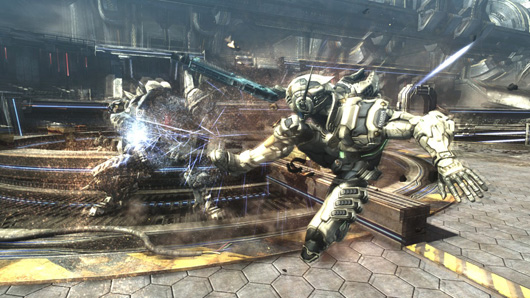
The gameplay in SW:TFU is done in the third-person ala God of War or Viking: Battle for Asgard, and is far more action-oriented than what you might have played in the demo. In the actual game, you will find yourself using your lightsabre a ton more as force grip requires you to stand perfectly still while controlling an object and, if you get hit, you lose that control. It is just not combat viable in hordes of enemies. Now, force lighting, THAT is an ability (especially when maxed out)! That’s right, as you progress through the game, you will gain points with which to customize your character – learning new force abilities and attack moves. The boss battles can be fun, however the game’s finishing system used to dispatch most is a bit awkward. Unlike God of War’s finishing system, this does not feel fluid or timed like you would expect, causing many missed attempts in the process.
Unfortunately, the camera can be down right awful at times, especially when in narrow passages or caverns. This is not only an issue in confined spaces, but the cinematic camera used when you fight Jedi is, again, awkward. They have tried to make it feel like you are watching a duel from one of the films, but it ends up just making everything difficult to see.
The camera will zoom out from behind you and move to some angle to try and frame the entire room in which you are fighting. Problem is, that when zoomed out, it is easy to lose your character (or the enemy’s) when the objects really start getting knocked about. Additionally, targeting between anything becomes more difficult as your perspective is off from your character’s (on which targeting is based). Aside from the camera, levels seem to spottily move from easy to insane in terms of difficulty level. While an increasing scale of difficulty is to be expected in most games, these seemingly random patches of insanity definitely keep you on your toes.
Overall, I cannot recommend Star Wars: The Force Unleashed enough. The game provides a much needed does of quality Star Wars story and excitement. The gameplay is not perfect, as I have stated with regards to the camera and whatnot, but these imperfections are a small price to pay for the wealth of goodness that otherwise lies within the title. Star Wars: The Force Unleashed…Do it, you know you want to!
Confused about our review system? Click here.
The X5 features a hard, black plastic design, save for the cap pieces which are rubberized, with a rubber scroll wheel and plastic vertical side buttons. The high-gloss, plastic center strip houses the scroll wheel, DPI, and Quick Turn buttons. Not a flashy gaming mouse, the X5 is only equipped with two rear-mounted undercarriage lights. Its minimalistic aesthetic gives an air of dignity to the mouse in a category where gamers often pay more for flash than function. Thankfully, the X5 makes up for its lack of lighting effects with a variable-DPI laser sensor.
Gone are the adjustable weights and interchangeable feet of the original Sidewinder, but they are not missed here in the least. The X5 shows that you do not need those frills in order to be effective in-game.
The keys are a hard plastic that do not feel like they belong. Thankfully, their action is nice with a good spring-back. If I had to suggest another feature on the next version of this keyboard, it would be to add a USB and audio port pass-through, something that is featured on many other keyboards in this price range.
You press this button, located along the top of the keyboard and then press the series of keys (up to four) you want it to remember. Finally, there is the keyboard’s ‘Cruise Control’ functionality, where you hold down the cruise control button and press a single key you wish to spam to your PC. Then release the cruise control button and it will go to work sending that key signal as if you were holding it down. Say you would like to auto-run in a shooter which does not feature such a key. Simply press the cruise control down, tap ‘w’ and release. Your character will continue running forward until you press any other key.


The goodies in question are a huge number of weapons, items, and modifications all based on their real-world counterparts. You purchase these items with points garnered from successfully winning games and killing your enemies. Purchasing something from the shop, you are given a choice as to how long you wish to keep the item (it costs more for the longer duration selected). This system of transactions (which will eventually include real-world money transactions) is in the UTMOST state of beta at the moment and is highly subject to change. There is also a chance that Nexon will offer several subscription models as well, but file that in the ‘rumor’ folder for now. As told to me from a company representative, development is firmly set in the realm of making the game as good as possible before they worry about the monetary system.
Combat Arms was the ability for your side to function as a cohesive team instead of getting myred down by complex gameplay mechanics. The gameplay is actually fairly simplistic, much like Dynamix’ Tribes was (and people STILL play that one). However this simplistic design ends up allowing a huge amount of complexity in how squads/guilds/clans will organize themselves and their plans to dominate the multiplayer games. Of course, there are always players who just want to run-and-gun, and that is fine for them. You will get a lot more out of the Combat Arms experience from getting involved in one of these squads.
The graphics in Combat Arms are pleasing, yet not too high-end. These graphics (and in fact the whole game) are made all the more impressive once you realize it is a relatively small client to download and free to play. Quality like this is usually found in retail boxes.
Design: The 5H V2 features a tough plastic construction with modular ear units nacelles which detach from the headband for easy transportation. Its ear cups are gigantic, enveloping all but the largest ears with a soothing foam the likes of which makes your ears feel like angel babies wrapped in a cloud. The headband is rather rigid and if your head is too wide you could have comfort issues. With my large cranium I was just pushing the limits of where the discomfort would begin thankfully, so I could enjoy the headset pain free. The boom microphone extends and retracts from the left ear unit on a flexible chord. This can make retracting the microphone tricky sometimes as the chord would rather flex than retract. The 5HV2’s cable for the microphone and headset plugs is made of a rope-like nylon, which is so much better than the standard rubber-insulated wires found on most headsets. This rope-cable is stronger and does not get tangled up as easily. Included is a huge extension cable for the headset, but I would have rather seen the base cable length extended by a couple feet instead.
Movies and Music: While you will enjoy this headset for your movie watching and music listening needs, you hardcore folk would probably be better served with a Dolby Digital-equiped multi-driver headset. For the general populace, I am happy to say music and movies both sound good and the comfort of the headset keeps on going through the entirety of the film or album and then some.
When I attend a press conference or private appointment at a gaming convention, I have always preferred to use a regular pen and paper whenever possible. I find that using higher-tech items just ends up getting in the way. As a student sitting in a professor’s lecture, I would sometimes miss an important point in my note-taking and have to scramble in my friends’ notes later to find out what I missed. These problems have plagued note-takers from around the world for quiet some time. Now, Livescribe has a solution to all your ills with their Smartpen Pulse.
Currently the word choices you can write out are limited but again, this feature is in beta and will be expanded upon soon. More of a toy feature, but probably useful for you aspiring musicians out there, is a virtual piano. Simply follow the instructions in drawing a simple nine-key piano keyboard and play music by tapping on the ‘keys’. The Smartpen Pulse is an open platform for software developers out there, and company reps tell me several third-parties are working on additional applications and games for the pen in the future.
The pen also includes a 3.5mm audio jack for your ear buds or headphones at the top of the unit so you can review your stuff without bothering those touchy neighbors.
You play as Baldur, son of the patriarchal Norse god, Odin. The game is set out in a third-person hack-and-slash format mixed with ranged weaponry. You start off selecting one class from five, and these range from the melee-centric to the ranged-centric, with a healer class in the mix as well. This class is the only class in the game that can heal itself. There is none of that Halo or Gears-style ‘stay put to recharge’ business to be found here. If you are not a healer, you will have to depend on mobs dropping healing orbs.
Repeat this pattern until eventually you reach a boss battle. Unfortunately, most of those tend to be uninspired, getting down to a rinse-and-repeat method of killing each one. Outside of the combat, even walking around in the massive (but generally empty-feeling) Aesir city takes forever just to get anywhere. Making things worse is that sometimes while on a mission, a goal area will not trigger from your presence, making you walk some distance away from the place and then back. This work around is not always successful, and then you have to reload your game.
Even as one of the combat-focused classes, you end up dying quite a bit when this happens and your AI squad-mates aren’t worth much more than human shields. The robots will also get abilities that can stun you. This is fine, except for the fact that the stuns last way longer than necessary, forcing you to yell at the screen quite a bit as you sit there waiting to die. The best part is when they stun you and you wait all that time just to be stunned again right when you break free. FUN!
The voice acting is generally alright, but the real problem lies in the script. The dialog is corny, pompous, and cliched. Chances are that you will probably be reaching for the mute button about an hour or so into it. The plot also falls apart somewhat during the middle portion of the game. Thankfully it comes back to the entertaining side towards the end, but the last couple hours cannot redeem the previous seven spent playing it.
The HS-1200 is a modest-looking headset: simple lines, light if not durable solid construction, and spartan overall design. Not saying the design is bad in any way, it is just not as flashy as many gaming headsets out there. It doesn’t feature any gaudy decals or quasi-futuristic curves where it doesn’t need them. In fact, it is easy to underestimate the HS-1200’s capabilities based on looks alone. That is, until you use the headset.
work nicely enough to produce virtual surround sound in the headset.
We found the sound coming from the 40mm Neodymium drivers to be crisp and accurate. In the Creative Console headset surround sound test, I originally had the volume up a bit too high and the sound of the helicopter they use was impressive as hell. Once I heard that, I knew I was in for a treat. While gaming, Creative’s CMSS-3D virtual surround sound is plenty useful in discerning relative direction of effects. OpenAL also comes through well with the headset. Using either of these methods in your gaming will yield good results. We tested the headset in Age of Conan, Crysis, and Battlefield 2142. In all cases we were more than pleased. The surround sound coming from the headset was immersive and enjoyable. We did not experience any strange anomalies, driver issues, or software glitches to speak of.