Sacred 2 Fallen Angel is one of those games which makes for a very tough review. On one hand, it does a ton of things well and, on the other, has a ton of stuff to be improved on. We shall explain…

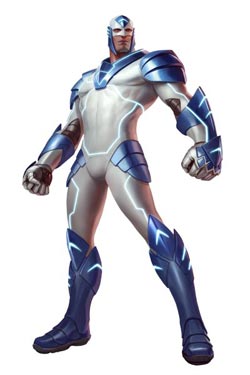
At the start of the game, you must select from quite a few options, each of which will tweak the gameplay experience somewhat. For openers, you have to select one out of six different characters to play as. Each of these characters is a different class and, as such, will directly affect your play style. For instance, the cyborg Temple Guardian character focuses on ranged combat with an energy weapon but also has a bladed weapon for close-quarters combat while the Shadow Warrior is strictly a melee-combat class. The cool thing about these characters is that they are well-developed and different enough to make you curious as to how each plays. Each character has a unique voice and personality of their own to boot, from the Temple Guardian who makes cracks at the expense of the game itself to the Shadow Warrior who’s gravelly, dry delivery of one-liners while he dispatches enemies reminds me of a campy Schwarzenegger flick (in a good way). You can select between a ‘good’ and ‘evil’ campaign mode (of the six characters, only three can partake in either one) as well as select a God to worship, each of which shall imbue your character with a special godly ability. For instance, worship the evil god Ker and you will be able to summon a nasty Sakkara demon to help you battle the forces of good, although the god’s hold on the demon doesn’t last long and then you will have to face off with it yourself.

After selecting a character you are treated to the opening cutscene explaining about the T-energy which emanates from within the planet and is the source of conflict in its inhabitants (people fighting for fuel? no way!). This pre-rendered, expository cutscene will give way to an in-game cutscene which introduces your character. After some introductory quests in the gameworld you are let loose to go about your business. Now, we have to say that the world of Acaria is gigantic and will surely provide you with hours of exploration. The environments are generally pleasing to look at with all manner of flora and fauna going about their lives.
As far as gameplay mechanics go, there really isn’t anything unique here. If you have played the aforementioned Diablo II or Titan Quest, you will be able to jump right into Sacred 2. Not that this is necessarily a bad thing, as the formula lends itself nicely to these hack-and-slash games and if it ain’t broke, why fix it! Sacred 2 does offer a couple of nice additions such as a button which will auto-loot everything within a pre-determined radius from your character, and the previously mentioned unique ‘god ability’. Characters will gain experience and levels and as they do you will be able to customize them further with unique skills and abilities.

Unfortunately, the narrative of the main quest just gets really lost in the game world and you will find yourself mainly spending your time hunting creatures and performing mundane quests all in the name of getting better gear and leveling your character. If this is not your cup of tea, you may wish to avoid this one. However, if you are a fan of multi-player gaming and love doing those things with your buddies you are in luck as Ascaron has included some great multi-player modes. There are PvP as well as PvE modes, and players can jump in and out of each others games. Spending a couple of hours with your mates killing mobs is a lot of fun and we have to give kudos to Ascaron for their attention to the game’s multi-player features.
While the game looks very nice, it is definitely suffering from some optimization issues. Our test rigs can run Far Cry 2 as well as Crysis (the original) at extremely high detail settings and get 50 to 60 frames per second. In Sacred 2, we are definitely seeing some slowdown. It is not unplayable by any means, but we are hesitant to see how it would run on a lower-end system without turning the detail way down. In addition, there were several times we would crash out of our single and multi-player games for some unknown reason. Then there is the game’s camera, which allows you to zoom in and out and rotate around your character. The problem is that the trees and other structures do not fade or become transparent when looking through them so it is easy to lose your character and select enemies if they are behind or under them.

Sound design is excellent in the game, with realistic ambient noises which really help sell the game world. Unfortunately, the voice acting in the game is often down right wooden. Now, the version we played was localized for the US, so we do not know if the original German actors were more natural-sounding.
Thankfully, none of this will really matter should you choose to play Sacred 2 Fallen Angel in a casual manner with your mates in multi-player. To us, that is where the game really stands out and is a lot of fun. It provides just enough narrative to keep things interesting and plenty of loot for your party to obtain. Unfortunately, the single-player mode can become very monotonous as you do not have the companionship of your mates to help you see past the game’s shortcomings. In addition, we hope Ascaron will continue releasing patches (as they have been) in order to fix the game’s instability and performance issues as the title definitely has a good deal of potential.
When we heard about this new HDD docking station from iStarUSA, we knew we had to try it out. Unfortunately, we have a ton of drives all over the place and their solution, especially since they billed it as hot-swap capable, sounded too good to be true. Thankfully, we have since then discovered that the xAge-N99SAU docking station is a welcome addition to our desktop despite a few limiting factors.
The biggest improvement over its slightly older brother, the N99US, is the addition of an eSATA connection. The front and sides of the docking station are clean, with no controls to speak of. There is an LED power indicator on the front, but its cool blue light is rather stylish. The ports and controls run down the back of the docking station. There you will find the AC power port, power button, and eSATA/USB ports.
Having been a longtime fan of flight simulators in general and especially great peripherals to go with them (I still remember my original CH Products flight yoke fondly), I could not pass up taking a look at Saitek’s new Proflight Headset.
Open-air cases are the latest thing in PC gaming enclosures. For years, many gamers chose to run their PCs with the side doors open and large external floor fans pointed at the components. While this solution provided good airflow, the components are still all mashed into a vertical ATX PC case. Plus, you would have to worry about keeping enough space around the case to place the floor fan.
The room is not nearly as plentiful in the below-mobo area where the PSU and internal drives are located, with snaking cabling about becoming a real pain at times. In addition, the way the PSU faces to one side takes away from valuable cable length when pulling cables to the opposite end of the case. These bottom-tier space issues aside, the ease of getting to your mobo components makes it well worth the trouble to be found underneath. Need to add a video card? Simply slide the component tray out the back of the unit and slap it in there, all easy like!
To make matters worse, Antec’s in-box documentation is not very good, and they refer you to the much more well-written online PDF. In the online document (available
As you can see, the Antec Skeleton consistently provides lower temperatures than the Lian Li thanks to it being more exposed to a cooler source of air. Cool air just spends less time turning hot and lingering around the Skeleton due to its open design.
SteelSeries has long been known as a developer of high-end gaming peripherals and their ‘7G’ gaming keyboards keeps to this tradition well. It is the most solid and well-made keyboard I have ever had the pleasure of using.
However, it is an all-metal design and can chafe if used for long periods of time. While SteelSeries has told us this design decision was made for durability purposes (gel rests can puncture and decay), and this makes sense, we recommend you put a soft barrier between the rest’s metal and your wrists for your own comfort.
This can be seen pretty much anytime your USB ports ‘freeze up’. While the PC processes what is going on, if you had a PS/2 keyboard installed it would still be able to pass on your key presses. Also, this allows the 7G to be used during your PC’s booting period where a USB keyboard might not have been detected yet. We would like to thank Mr. Rom for his helpful answers.
Conclusion: If you are looking for the best ‘functional’ gaming keyboard possible, the SteelSeries 7G gaming keyboard is exceptional and well-worth its $150 dollar price point in that it very well could be the last keyboard you need to buy until the apocalypse, maybe. Even then, the thing might just hold-up fine. Unfortunately, nuclear testing was not part of our review regiment. Also, we cannot say what the value of the beast will be in bottle caps. Sorry, we have been playing Fallout 3 too much. The biggest complaint we can find about this keyboard is the lack of back-lighting. If you can get over not having the ‘bells and whistles’ and are able to afford it, the 7G is easily the keyboard for you.
‘War. War never changes’. It is with these words that began one of the greatest role-playing games ever made (of course I mean Fallout). The RPG and its sequel are renown for their tongue-in-cheek humor, stylistic design, and isometric gameplay. When we heard Bethsoft was taking the reigns on Fallout 3, and that it would be a first-person game, forums around the ‘net lit up with flame wars on the subject. Die-hards of the series naturally had a worry that by bringing the series into the first-person, Bethsoft would be taking away an aspect which made the previous games undeniably ‘Fallout’. We are pleased to say, however, that this worry has proven itself false. This is a Fallout game.
Thankfully, if you can get past the sense of sadness for the human race as a whole, you will find a gigantic amount of things to do and see. Quests can be found in abundance and it is very doubtful you will finish everything in one play through. In fact, your character’s level is capped at 20, making it very likely you will play the game over again at least a few times, trying different character builds. Bethsoft has stated numerous times that they wanted to increase the re-playability of the game immensely and they have succeeded in this feat. Of course, the low level cap is also probably some foreshadowing that forthcoming DLC will raise it somewhat for added quests, etc.
When you are ready, simple click accept and the fun begins. The results of your stacked actions are shown in a cinematic, bullet-time, method with various camera angles and the like. The V.A.T.S. combat system can lead to some VERY cool-looking combat. For instance, using my Chinese pistol (which makes me feel a bit like Han Solo) I initiated combat with a raider. I queue up V.A.T.S. and assign two shots to the body, one to the left leg, and the last to the head and then click accept. The following ‘cut-scene’ (and I use the term loosely as it is all done in-game) blew me away and was completely unexpected. My two shots to the body blew the raider back a bit, obviously wounding him deeply. He turned around and began to run in an attempt to escape my wrath but he was not fast enough. My shot to his leg crippled him, sending him to the ground in a heap. My last shot finished him off with spectacular gore and violence. This kind of scenario does not happen all the time. However, it happens enough to make you want to continue using V.A.T.S. whenever possible. Using this mode drains you of action points (or ‘AP’) which must be recharged in real-time mode. This is just another example of the great lengths Bethsoft took in making Fallout 3 accessible to new gamers as well as fans of the original RPGs.
A new feature in Fallout 3 that we have not seen before in the series is the ability to own your own home. In certain areas and by accomplishing certain tasks, it is possible to own your own residence. This provides you with a free place to rest and heal up as well as the ability to customize it with house-specific items like jukeboxes, first-aid stations, and more.
GMC, a Korean company, has been making its mark on the North American PC case market for a short time now. They usually offer cases with plenty of cool features and eye-popping designs. Their first gamer-specific enclosure, the X7 ‘X-Station’ is no different.
The X7 is designed with militaristic-looking black lines which lend themselves well to the gamer-centric motif. It actually reminds me of something you would see in Batman’s ‘Tumbler Batmobile’. The bezel features a couple of cool orange power lights as well as four USB 2.0 ports, power button, and reset button. We would like to have seen an eSATA and/or FireWire port on the front, but we digress. The X-7 also features a backlit LCD display which shows the case temperature and fan speed.
Inside the case, there is just enough room to accommodate a gtx 280 video card, making cabling somewhat of a challenge. This is not out of the ordinary though, as most cases have issues in this department.
The case allows for up to four 3.5” drives to be installed, right behind the 80mm forward area fan to promote hard disk cooling.