

Yesterday it was reported that Funcom has launched the ‘Gangs of Tarantia’ update for their MMO Age of Conan. Today we have a special developer walkthrough of the new high-level zone in the game: the Tarantia Commons. Enjoy!
Yesterday it was reported that Funcom has launched the ‘Gangs of Tarantia’ update for their MMO Age of Conan. Today we have a special developer walkthrough of the new high-level zone in the game: the Tarantia Commons. Enjoy!

If last week’s LIVE, streaming sneak-preview of LucasArts’ The Secret of Monkey Island SE left you clamoring for more, you are in luck! Tomorrow at 1pm PST, they will be continuing the demo for your viewing enjoyment. So check back in then to watch LIVE!

Microsoft has announced the recommended price points for both the full and upgrade versions of their upcoming Windows 7 OS. Due out October 22nd, the new operating system pricing breaks down like so:
Upgrade Versions
* Windows 7 Home Premium (Upgrade): $119.99
* Windows 7 Professional (Upgrade): $199.99
* Windows 7 Ultimate (Upgrade): $219.99
Full Versions
* Windows 7 Home Premium (Full): $199.99
* Windows 7 Professional (Full): $299.99
* Windows 7 Ultimate (Full): $319.99
Also, if you want to pre-order the OS tomorrow, Microsoft is offering a 50% discount to all versions except the Ultimate Edition (darn it). This 50% discount offer is valid until July 11th.
Via WindowsTeamBlog

If you did not get the chance to read our review of Bohemia Interactive’s Armed Assault 2, you can now at least play the demo before picking the game up. BI has released the 2.6GB demo which features just a small part of the 225,000 square mile ex-Soviet Republic of Chernarus.
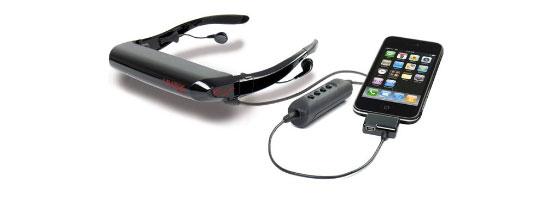
Vuzix has taken the lid off of its AV310 video eyewear system. Capable of recreating a simulated 52-inch, 16×9 screen right in front of your eyes, the AV310 can grab video from just about anything with a component output (hello Xbox 360!) or even your iPhone 3G. Most incredibly is that the AV310 is capable of producing those cool stereoscopic 3D images you see in the 3D IMAX movies and whatnot. So, when 3D versions of your favorite flicks hit the consumer market you will not be out of luck.
Official Release:
Vuzix is pleased to announce the AV310, the world’s first true 16 x 9 widescreen video eyewear, is fully compatible with the new iPhone 3Gs and all major 3-D video… (cont.)
(cont.) …formats. Users are able to access all their 2-D and 3-D video content stored on the iphone and view it on the AV310’s simulated 52-inch big screen.
Equally as important is the AV310’s ability to display all major 3-D content formats. As 3-D reemerges as a major video format, consumers are now demanding that their products be compatible with the content formats and hardware of the future.
When Amazon released its Kindle 2 in February of this year, I thought my prayers had been answered. That device saw the re-design of the original Kindle along with a newer E-Ink display as well as increased storage capacity, things were looking up for my e-reader purchasing needs. However, I held-fast and did not buy right away as I remember several experiences with being an early adopter that ended up biting me in the rear end. Thankfully my gambit paid off and in April of this year Amazon announced the Kindle DX.
As you can see, the Kindle DX looks very similar to the Kindle 2 but obviously much larger in size. It measures 10.4” by 7.2” and is 0.38” in thickness. Like the previous Kindles, the DX features a white exterior with silver backing and very spartan style which wreaks of Apple-influence. Not that we are complaining, if you are going to lift the design style off of one company in today’s economy, Apple is a great choice.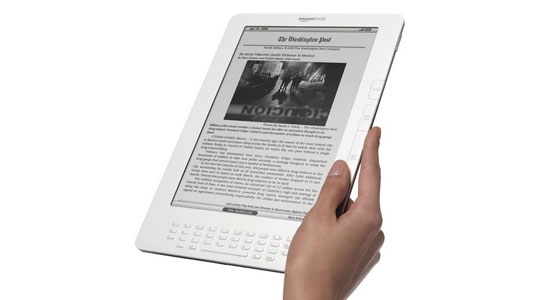
Key differences from the Kindle 2 aside from size is that Kindle DX has a 9.7” (diagonal) E-Ink display. It is capable of the same 16-levels of grayscale as the Kindle 2’s screen – its just bigger. In fact, the Kindle DX’s screen is about the exact same size as the entire Kindle 2 device! The control-array on the right side of the DX is similar to the array on the Kindle 2, however the five-way directional nub is a bit more raised and usable on the Kindle DX. Another big change from the Kindle 2 is that the Kindle DX features a keyboard of reduced size which makes usage not as user-friendly as the previous model. Its odd-shape and size definitely take some getting used to. Amazon has included 4GB of internal memory on the Kindle DX, double that of the Kindle 2. However unlike the Kindle 2 the Kindle DX does NOT feature an SD memory card slot.
An internal sensor detects whether the Kindle DX is being held in landscape or portrait modes and rotates the display to match. This is a nice feature to have but I found myself sticking with portrait mode most often. This could have been just sheer force of habit or perhaps I did not have any e-docs that needed landscape reading. For normal reading needs, even in newspapers, the Kindle DX’s large screen does great in portrait mode.
Returning on this third Kindle device is the much-heralded, and controversial, text-to-speech feature from the Kindle 2. While the vocal reproductions are good they are still a far cry from actual human speech and I can’t imagine it being used in practical application. Besides, you are buying an E-Reader to read! If you wanted to listen to your books there are much cheaper options with better production values.
As far as its size is concerned, from a functionality-standpoint it is perfect for what Amazon has said is the Kindle DX’s core market: Educational institutions and business professionals. Jeff Bezos mentioned in his unveiling of the Kindle DX that the plan was to have educational institutions subsidize purchases of the DX for students and for textbook-producers to offer Kindle DX versions of their weighty products. Thus far this has not come to pass, but as a former-university student I can tell you that if I had the choice of carrying around all of the books I did or just the Kindle DX I would choose the E-Reader everytime. While the Kindle DX is an expensive device, if purchased for a discount at the beginning of one’s college career it could literally be the best investment you make besides the coffee you need to keep you going through all-night study groups.

As for you business professionals out there, you will probably enjoy the Kindle DX’s native PDF support. Unfortunately, you cannot do much with the PDF aside from view it. There is no way to zoom in on the document or anything like that. The Kindle DX simply scales the PDF to the size of the screen and displays it. While useful, if the PDF features very small text, it can become unreadable should the DX scale it down too much. Aside from this problem, if the PDF is created smartly, with moderately sized fonts, it allows for a very easy to carry around your memo’s, project proposals, etc.
As I mentioned before, the educational front of the Kindle DX features has been a bit too quiet for my tastes since the initial announcement. This piece of the puzzle alone could revolutionize how students move around from class to class. It will go far to alleviate student backstrain, that much is at least certain!
Unfortunately one of the best assets of the Kindle DX, its size, is also a bit of a downside as well. While having the extra screen real estate proves to be a much improved reading experience in comparison to the Kindle 2, it also makes it harder to carry around with you. Plus, Amazon still is not including a sleeve for the unit making you purchase one after the fact for around an extra $50 bucks! Seriously Amazon, for $489 dollars I want to have an included sleeve or cover.
The Kindle DX is not cheap. At $489 dollars it is an extremely weighty purchase. If you are already the owner of a Kindle E-Reader, you may want to pass this one by and wait for the Kindle 3 unless you can get a good re-sale amount to offset the Kindle DX’s price. However, if you are new to the E-Reader market, I would say go with a Kindle DX hands-down. It may not be a perfect device, but out of all the E-Readers on the market it is easily the best yet.
The Kindle DX Official Product Page
Armed Assault II, or ‘ArmA II’, is the sequel to the popular war game Armed Assault which was the spiritual successor to the popular war game Operation Flashpoint. If that last one sounds familiar to you, it is because Bohemia Interactive Studio (BIS) were the game’s developers under the watchful publishing of Codemasters Interactive. The upcoming sequel to Operation Flashpoint is, good or bad – depending on your view, not being developed by BIS. So now that the history lesson is over and done with let’s talk about Armed Assault II.
Armed Assault II is, like its predecessor, divided up into multiple areas of play. In the singleplayer modes you can train in multiple boot camp-style scenarios which do a fine job of preparing you for the various elements of gameplay you will encounter. The campaign can be played locally or hosted for your buddies to join in and is a real improvement over the first game’s campaign.
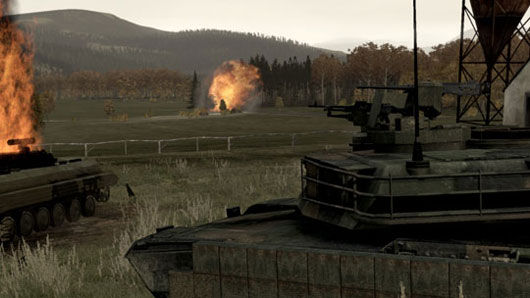
In Armed Assault 2 you find yourself on the ex-Soviet republic of Chernarus in a battle with multiple factions all duking it out for their own agendas. Your character is part of a United States Marine Corps Force Recon team known as ‘Razor’ and are the cream of the crop, as they say. However, don’t go thinking you are the bloody Master Chief here or anything – you are VERY vulnerable, as anyone who has played the original Armed Assault knows. Wounds are not taken lightly – a couple of moderate hits and you are a goner! Thankfully, this area of the hardcore gameplay has been toned a bit with the introduction of a first-aid system where team mates can heal one another if the injuries are not too mortal. You can even drag your wounded soldiers about to cover if necessary.
Aside from this improvement the campaign feels very similar to the first game’s and any ArmA vet should feel right at home relatively quickly. New players would be wise to go through all of the Boot Camp missions as well as have a friend who has played before show them the ropes – a great opportunity to cooperatively tackle the game right off the bat! ArmA II has a high learning curve, spartan user interface, and non-standard shooter controls which serves to complicate the matter. For example: In most shooters, pressing one of the number keys will change your currently-selected weapon. In ArmA II, you use those to access the commands menu for whatever soldier or unit is assigned that particular number.
Missions, unfortunately, are a bit wonky in terms of triggers and end goals. Being that ArmA II takes place on an ambitious 225,000 square miles of land, all of which are open to you, brings some problems with the linear mission formula. Performing a task out of sequence or altering the current mission by bringing in something unexpected like bringing a vehicle from somewhere else can screw up the triggers the game uses to pace out, and detect, mission objectives. When this happens it usually means your mission is stuck in limbo, being cursed never to end, your only recourse to restart it.
Unit artificial intelligence has definitely been improved upon but is still subject to bouts of ‘brain freeze’, especially in vehicles where an NPC is the driver to your gunner. Issuing orders to the unit often causes them to pause as they plan out what you just told them to do. This hesitation is sometimes just enough to get you killed or throw off your aim. When the artificial intelligence works, though, it really works and sometimes you will forget the person you are shooting at, or is shooting by your side, is actually an AI. Couple this AI, which is also dynamically ‘thinking’, with the previously-mentioned ‘wonky triggers’ and every play-through is a surprise, positive or not.
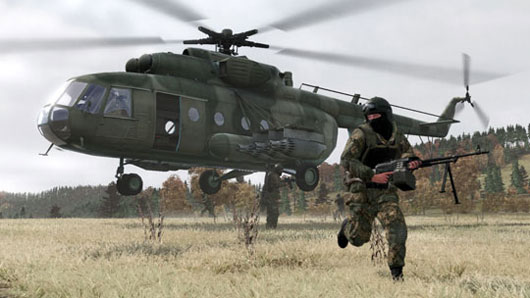
The bug-factor in the North American release, while not nearly as bad as the earlier European release, is still a real bother. I experienced more than a few CTDs and freeze-ups throughout my playtime with the game. Going by the European release (pre-recent European patch), this is a big step up. That being said, when looking at the attention BIS has given to the original ArmA over the years in the way of patches and enhancements, I have every confidence these bugs will be mostly worked-out within six months.
ArmA II features some very stellar visuals given two things – your graphics settings and your PC hardware. The first time I began playing the game I felt literally hornswaggled as the graphics appeared grainy and rough, not at all anti-aliased or smoothed out. In perusing the options though, I found that by playing with the ‘fillrate optimizer’ I could get the game to look like all of those spectacular screenshots! Unfortunately, the test rig’s Intel i7 2.6gHz CPU, GTX 280 video card, and 6GB of DDR3 RAM were just not enough to handle this quality and I realized with those graphics settings all I could do was take pretty screenshots. This is not really a bad thing or downside – it is actually a positive point. ArmA II is big, real big, and it needs a very powerful machine to run it at maximum. It will be a pleasure to grow into it as PC technology becomes less expensive. I have come back to so many games a year down the line and realized that they aged in the most awful way when compared to what’s new on the market. I have a feeling that Armed Assault II will not be one of them. Don’t fear, by tweaking the graphics settings a bit I was able to find a happy medium between pleasing visuals and performance – and so will you.
Reviewing the North American version, I have to mention the game’s awful voice acting. Most of the characters in the campaign sound extremely wooden and amateur at best. I must caveat this by saying that the actors are non-native English speakers which is most likely the cause of this poor acting. In their respective native dialects I am sure they are more than fine, just not in this version of ArmA II.
In the multiplayer menu you will find the ability to jump into player-created servers with multiple randomly-generated missions and types (CTF, C&H, and more). This adds a ton of spice to the mix and co-op and versus play with other people is really where ArmA II shines like nothing else. Again, this is definitely more of a war simulation than shooter – Battlefield 1943 it ain’t, and thankfully so, just be prepared for that.
The mission editor which made ArmA so popular and still keeps it burning brightly among fans is back and allows gamers to build all manner of missions, from the droolingly-simple to insanely complex by way of the built-in scripting language. If multiplayer is where the game shines, then the editor is what does the shining. All one has to do is look at the hundreds of fan sites out there churning out player-made missions as well as other mods – vehicles, weapons, etc to know this.
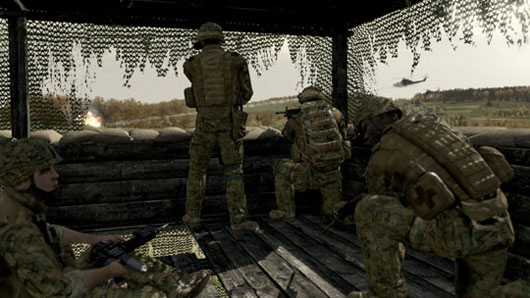
One feature which brought a bit of a break to the normal goings on of ArmA was ‘The Armory’ – a place where the gamer could try out the various weapons systems available in the game and take them on different challenges. BIS has brought the mode back in the sequel, and completing these challenges will result in more systems being unlocked for you to try. For instance, if you try the USMC M2-equipped Humvee, you could be asked to drive an obstacle course or even charge an enemy encampment! While not the main focus of the ArmA II, this mode provides a lot of entertainment in its own right.
Overall, Armed Assault II is an exceptional war-simulation that is just the thing for those gamers looking for extreme realism and depth. It definitely has its current stable of issues, but none of them are things that can’t be patched and, in the meantime, when the game runs as promised it really does feel like being part of a gritty and intense war. I can’t think of another title out there right now that fits the Armed Assault II bill in terms of its scope and multiplayer capabilities.
Speaking of which, I am Oscar Mike dear reader – have to get a game going. You can find more on Armed Assault II at the official game website.
LucasArts has announced that it will be streaming a special sneak-peek demo of their upcoming The Secret of Monkey Island: Special Edition this Friday, June 19th, at 3PM PST. Be sure to check back to this article to watch it live!
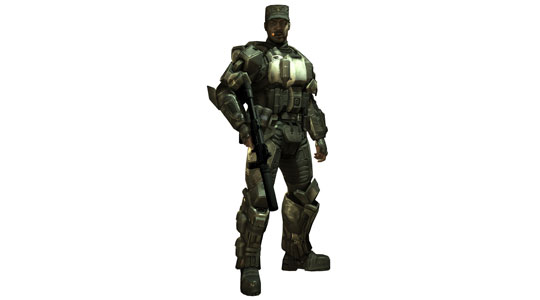
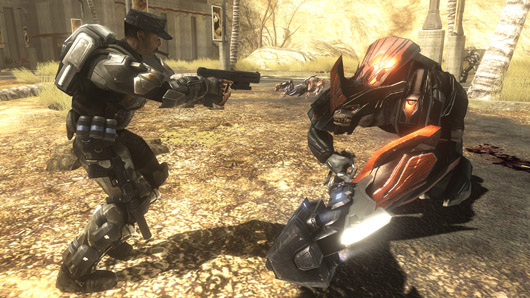
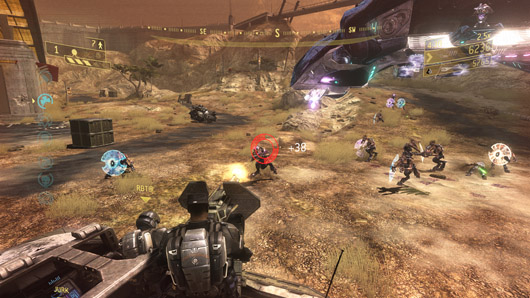
Bungie has released some new screenshots from its upcoming Halo 3 expansion, Halo: ODST. Due out September 22nd on the Xbox 360, we learned during Microsoft’s E3 press conference that if you purchase the expansion you will be eligible to take part in the multiplayer beta test for the next big Halo project – Halo: Reach.
Check out the three new screenshots After the Break…because Sgt. Johnson says so and you better listen up as he will be a playable character in the upcoming expansion! *UPDATE: He is playable only if you pre-order ODST and only in one of the new multiplayer modes.


I remember back when point and click adventure games ruled the world of video games. One of my favorite memories is of spending hours with the Monkey Island series melting into the story. One of the big surprises of E3 2009 was the announcement that not only was the original Monkey Island game getting re-done for Xbox Live but a new set of adventures would be coming out as well.
Telltale Games and LucasArts set into motion Tales Of Monkey Island for the Wii and PC. A brand new tale set a few years after the last game.. (cont) (cont.) …where our hero, Guybrush Threepwood, has taken away the mojo of the evil pirate Lechuck. Doing so has released evil voodoo magic across the Caribbean and somehow infected his own hand with voodoo powers. Guybrush is off to find a cure in the elusive exfoliating sea sponge ‘La Esponja Grande’.
Let me tell you just how great this game looks – It brings back fond memories of the original games and a quality of humor that is very much missing and very much-needed in today’s games. We got a little tour of one of the port towns and everything really stood out graphics wise. The backgrounds were made as a nod to the original games as 2d backgrounds while everything up front seemed to come at you like a pop up book. Telltale is really good at keeping things ‘as they were’ but just refined enough to where it feels fresh and new.
In any adventure game sound is important and we were assured that many of the original voice actors were going to be back to reprise their roles. Michael Laird is back doing a brand new music for the series and that grabs another hook into the old school fans of the game.
We were not able to see much of the control scheme as the person giving the demo let us know that they were still in development but there is an interesting new thing for beginners. There will be a built in hint system for beginners that will guide them to their destinations. This will usher in a new generation of fans as people can play without being put off by the style of the game. Fear not old school members as we were assured that this system can be turned off as well. One other nugget of information that we were dropped was that there will be a system to combine items in the game and that should make for some interesting puzzles.
Tales Of Monkey Island is all about the story and that is what Telltale Games has always done best. I expect there to be lots of cliff hangers at the end of each episode and, hopefully, it will continue after the first season should the fan base be hungry for more. The entire first season will consist of 5 episodes with one releasing every month and the first episode is set to drop on July 7th for the PC and Wii. We asked if this will be released for Xbox Live as well and it was something they are hoping for, but no official announcement was made during the demonstration.
Tales Of Monkey Island was the surprise of the show for me and I can’t wait to get my grubby little hands on it. Coupled with the reloading of the original game I believe that Telltale and LucasArts are bringing back the old school games for a whole new crowd to enjoy. Make sure you pick Tales Of Monkey Island up and check out the awesome pre-order bundle at Telltale’s site.