
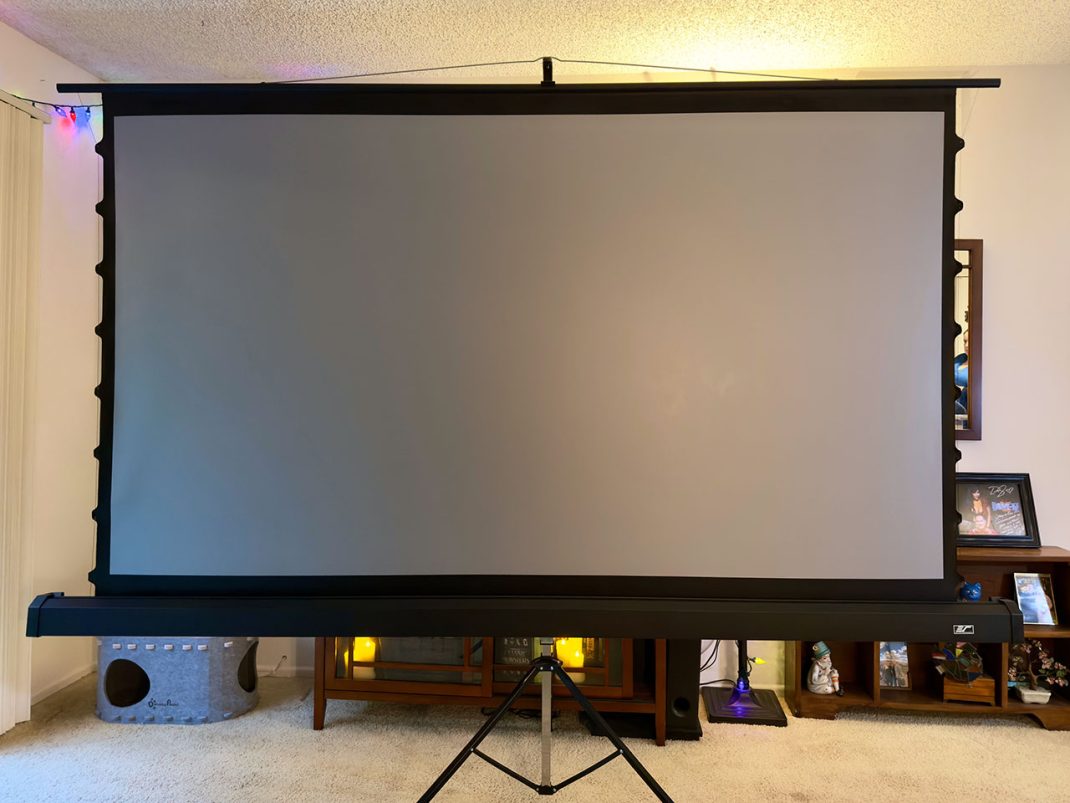
In the world of projection, achieving a vibrant, high-contrast image often requires meticulous control over room lighting. Darkened rooms, non-reflective walls, and careful projector placement have long been the hallmarks of dedicated home theaters. However, the reality for many is far different – presentations occur in brightly lit conference rooms, movie nights happen in family living areas with ambient light spill, and sometimes, you just need a screen you can set up anywhere without dedicating permanent wall space. It’s precisely this intersection of challenging lighting conditions and the need for flexibility that the Elite Screens Tripod Tab-Tension CineGrey 5D series aims to address, and the 103-inch model offers a compelling balance of performance and portability.
At the heart of this screen lies its most significant feature: the CineGrey 5D screen material. This isn’t your standard matte white or simple grey surface. It’s an advanced, multi-layer material engineered as an Ambient Light Rejecting (ALR) and Ceiling Light Rejecting (CLR) surface. Employing angular-reflective technology, it uses precisely structured reflective and absorbent micro-particles designed to filter out up to 75% of ambient light striking the screen from off-axis directions. This means light from overhead fixtures, lamps, or even windows hitting the screen from the sides or above is largely prevented from washing out the projected image. Simultaneously, the material is engineered to reflect the light coming directly from a standard-throw projector squarely back towards the viewing area. The result is a dramatic improvement in perceived contrast, black levels, and color saturation, particularly in rooms where controlling ambient light is difficult or impossible. For presentations in typical office lighting or enjoying a film in a living room during the day, the CineGrey 5D makes a tangible difference, preserving image punch where a standard screen would look pale and faded. For my apartment setting, this large screen is a dream come true. My setup consists of XGIMI Horizon S Pro projector and a smaller XGIMI Elfin Flip projector. My main projector for this screen will definitely be the Horizon S but I included the smaller projector for comparison. You will read this more than once in this review, but the Elite Screens 103″ CineGrey 5D Tripod Tab-Tension Screen is not meant to be used with short throw projectors.
Complementing its light-rejecting properties, the CineGrey 5D material boasts a 1.5 gain. This means it reflects 1.5 times the brightness of a standard unity-gain (1.0) screen. This added brightness works synergistically with the ALR properties, helping the projected image compete more effectively against residual ambient light. It can also be a boon for projectors with modest light output, giving their image an extra boost in vibrancy. Furthermore, Elite Screens has ensured this performance doesn’t come at the expense of color fidelity; the material is ISF Certified for accurate color reproduction, ensuring that viewers see colors as the content creators intended, maintaining D65 color temperature and dynamic range standards. This commitment to quality is crucial for both critical viewing and ensuring presentations look professional. It supports resolutions up to 4K and even 8K Ultra HD, along with Active 3D compatibility, making it future-proof for high-resolution content. Using our projectors, I was unable to test the 8K Ultra HD and Active 3D abilities, but based on how it handles 4K content I have no doubt of its performance at those higher standards.
However, this specialized material does come with specific requirements and characteristics. Its angular-reflective nature necessitates the use of standard throw projectors – models placed a significant distance back from the screen. It is explicitly not compatible with Ultra Short Throw (UST) or Short Throw projectors, whose steep projection angles would be reflected incorrectly. Elite Screens recommends a minimum throw distance of 1.5 times the image width. In the case of the 103 inch screen, that means that the projector should be at least 12.8 feet from the screen if you are using the entire viewable screen area. Additionally, the viewing angle is narrower than a typical matte white screen, specified at 80 degrees (40 degrees left or right of center). Viewers seated significantly off-axis will notice some drop-off in brightness. This makes it ideal for seating arrangements focused more directly in front of the screen. Potential buyers should be aware that some minor “hot spotting” (a brighter area in the center) can occur, though in my testing of the screen the increased gain of the material overall minimizes this effect and it should not deter a purchase so long as you know what your use case for a projector screen is (e.g. not using a short throw projector with a standard/long throw screen).
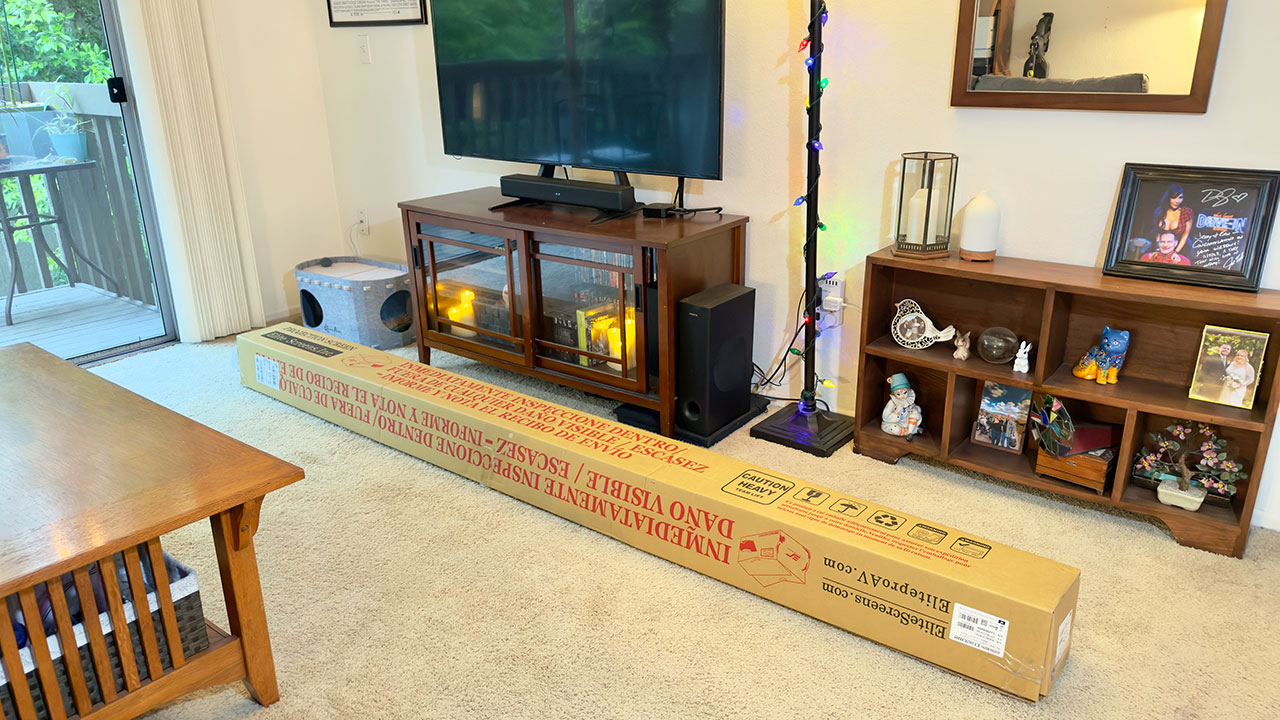
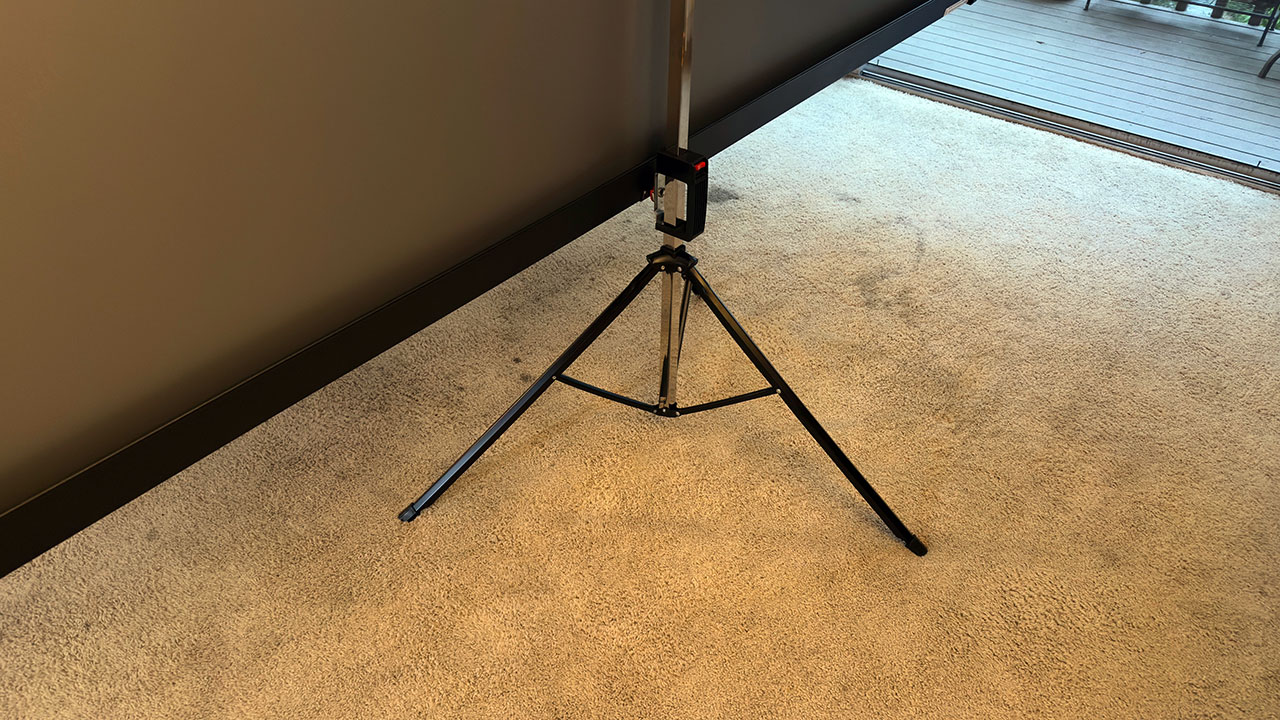
Beyond the advanced screen material, the physical design of the 103-inch Tripod Tab-Tension model emphasizes portability and image fidelity. The tripod stand itself is straightforward, allowing for quick deployment. An auto-locking mechanism provides variable height settings, making it easy to position the viewing area appropriately. A built-in carrying handle and an included standard carrying bag underscore its portable nature, making transport between rooms or locations convenient. While it weighs about 26 pounds, which is not light for most people, the design and portability features make it feel a lot lighter than it is, greatly increasing its ease of handling. Also, the screen is about 104 inches long when in its carrying bag. That’s over 8.5 feet! Again, this is not a small screen so just be sure you take that into account before purchasing (or attempting to transport) it.
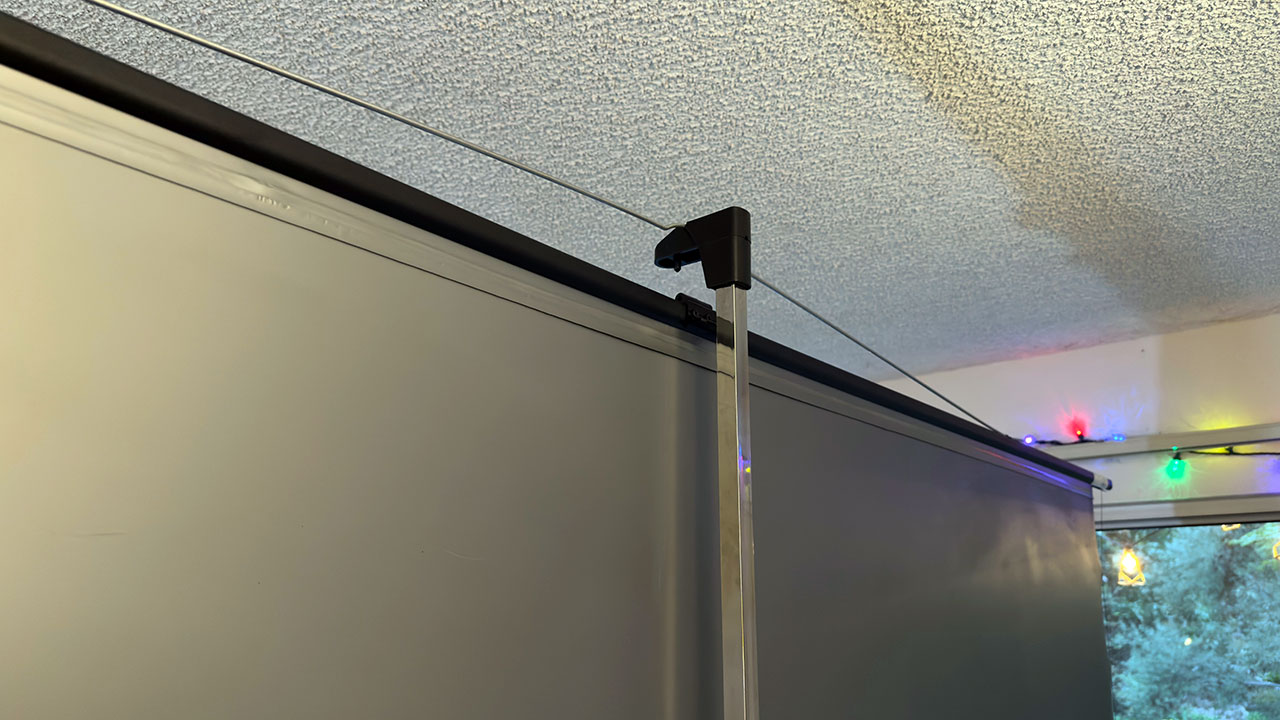
This model incorporates a tab-tensioning system and is one of the best features of the screen. Tabs on the sides of the screen connect to a tensioned cord running along the edges, pulling the surface taut and ensuring it remains perfectly flat and free from waves or ripples. This is essential for maintaining image geometry and sharpness, preventing the distracting distortions that can plague non-tensioned roll-up screens. In several other projection screens I have experienced, the rippling and waving of the screen material was a real bummer – especially when trying to screen a new film on your expensive projector. Standard black masking borders frame the 16:9 viewing area, enhancing perceived contrast and absorbing any slight projector overshoot. Elite Screens even includes a black fabric skirt to cover the open area between the screen and the floor.
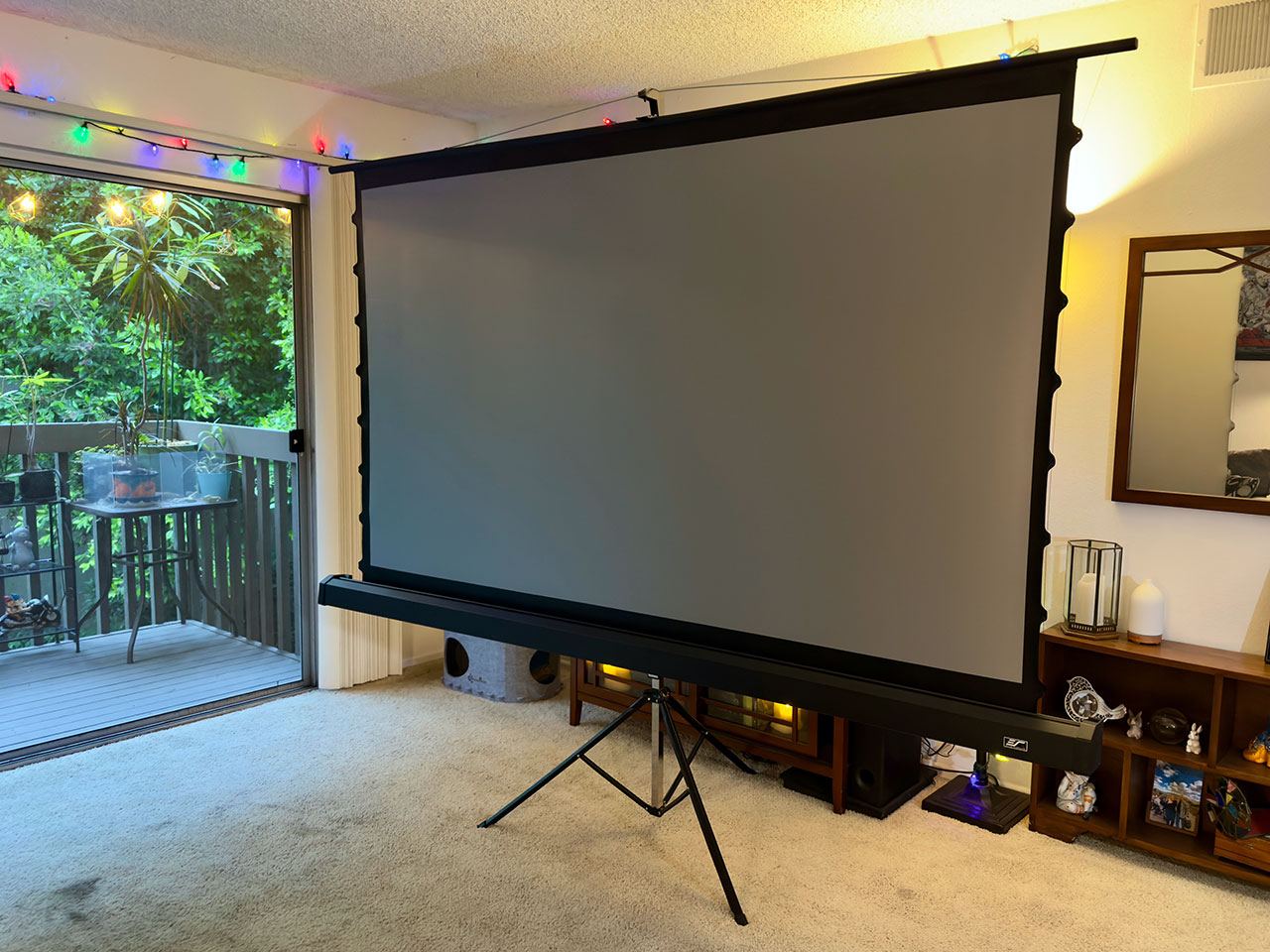
Considering its feature set, the Elite Screens 103-inch Tripod Tab-Tension CineGrey 5D projection screen occupies a unique space. With an MSRP of $795, it represents a significant investment compared to basic portable screens. However, for users specifically needing strong ambient light performance combined with the flexibility of a portable, easy-to-set-up, tensioned screen, it offers substantial value. The blend of the high-performance CineGrey 5D material, the essential tab-tensioning system for flatness, and the convenience of the tripod design creates a capable solution for challenging viewing environments where permanent installations aren’t feasible. For those whose primary challenge is ambient light and who need a screen they can easily deploy (and have the storage space), the 103-inch Elite Screens Tripod Tab-Tension CineGrey 5D is a highly competent and well-considered option, provided its projector compatibility and viewing angle limitations align with their setup.
Overall Rating 5 out of 5
Pros:
- Excellent ambient light rejection capabilities significantly improve contrast and saturation in bright rooms.
- Tab-tensioning system ensures a perfectly ripple-free viewing surface.
- 1.5 gain provides a brighter image.
- Portable design with easy setup/takedown, tripod stand, and included carrying bag.
- Supports high resolutions (4K/8K) and 3D.
Cons:
- Only compatible with standard “long” throw projectors (NOT for UST/Short Throw).
- Viewing angle (80 degrees) is narrower than most matte white screens.